


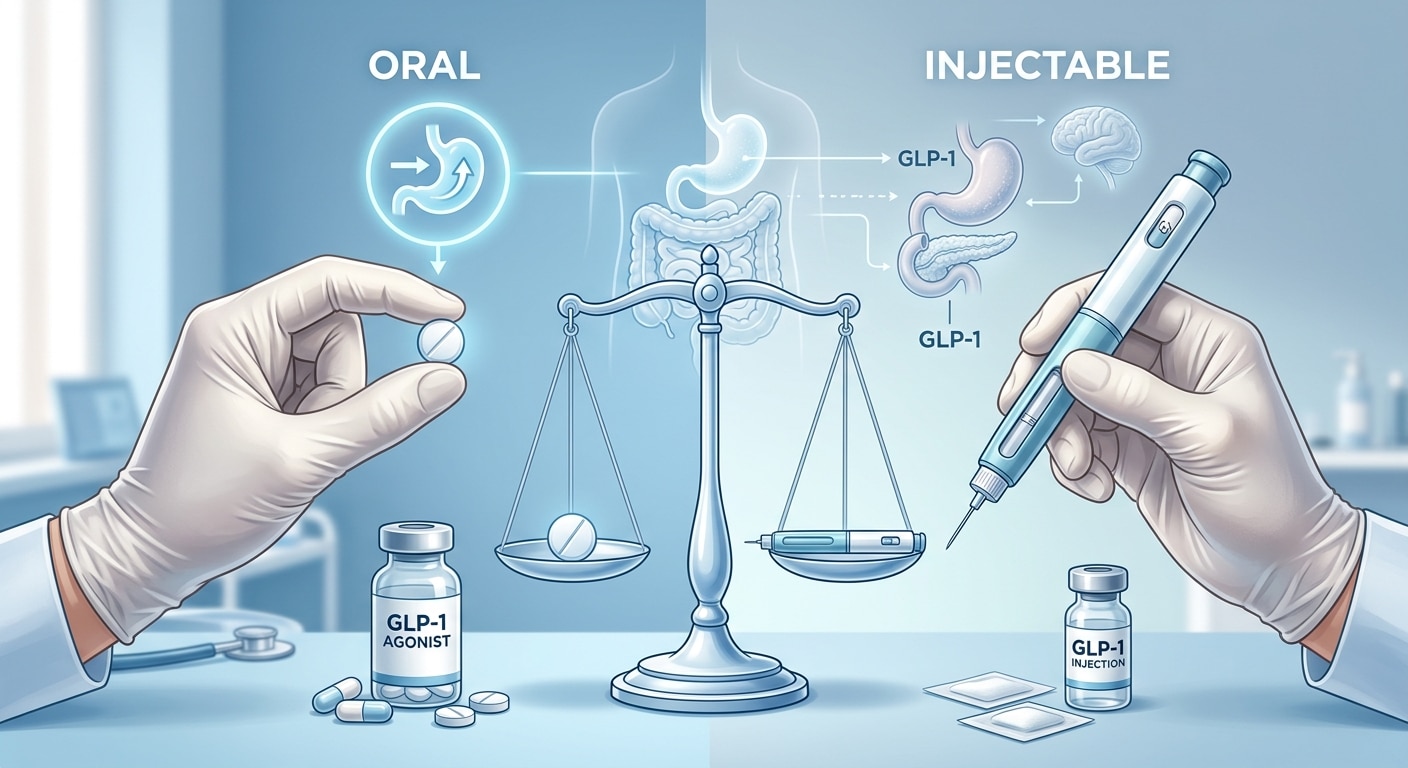
The Needle vs. Pill Debate: Why Your GLP-1 Choice Is About More Than Just Preference
You’ve decided to pursue GLP-1 therapy—smart move. But now comes the fork in the road: needle or pill?
If your primary care doctor just said “pick whichever you prefer,” they weren’t wrong, but they also weren’t telling you the whole story. The answer is more nuanced, more behavioral, and honestly more interesting than raw efficacy numbers.
The Efficacy Reality Check: Both Work, But Not Equally
Let’s start with what the latest research actually shows.
Oral medications — including semaglutide and orforglipron — deliver solid results:
- Oral semaglutide (OASIS-4 trial): ~14% average weight loss over 68 weeks
- Orforglipron (ATTAIN-1 trial): ~11% average weight loss over 52 weeks
Injectable medications — especially tirzepatide and Ozempic/semaglutide — still hold the top spot:
- Tirzepatide continues to show 20%+ weight loss in real-world cohorts — for a detailed head-to-head breakdown, see our guide on semaglutide vs. tirzepatide
- Weekly dosing simplicity often translates to better long-term outcomes
The clinician’s take: Both routes absolutely work. But if raw power matters—if you’re aiming for the biggest metabolic shift—injectables still have the edge.
That said, efficacy is only part of the story. Most people don’t quit because the medication failed; they quit because life got in the way.
The Adherence Paradox: Why Weekly Beats Daily (Even With a Needle)
Here’s where behavior beats biology.
A daily pill sounds convenient. A weekly needle sounds like a burden. But the data tells a different story—and it’s rooted in something called routine burden.
Taking a pill every single day is a habit you have to build from scratch. You have to remember. You have to integrate it into your morning routine. You have to manage the timing around meals. If you miss a day, guilt sets in. By week three, when life gets chaotic, adherence starts to slip.
Weekly dosing (whether needle or pill) works differently. It’s a ritual. A Monday morning injection takes 10 seconds. A weekly injection day becomes a calendar event, a moment you own and plan for—not a daily micro-decision that wears on willpower.
The Rodriguez JAMA 2025 analysis found that weekly dosing schedules showed 64% better adherence at 6 months compared to daily oral regimens, regardless of whether the weekly dose was a needle or a pill.
The neurological truth? Your brain isn’t optimized for daily repetition. It’s optimized for rhythmic events.
The GI Factor: Why Nausea Gets All the Blame (But Shouldn’t)
Let’s talk about the elephant in the room: nausea.
Gastrointestinal side effects—nausea, vomiting, constipation—are the #1 reason people stop GLP-1 therapy. Not efficacy. Not cost. Not needle phobia. Stomach issues.
Here’s what you need to know:
GI symptoms are route-agnostic. Whether you’re getting semaglutide by injection or by mouth, your GI tract doesn’t care. The nausea comes from the drug itself (it slows gastric emptying), not how it enters your body.
What does matter:
- Dose escalation speed. Rush it, and GI side effects are brutal. Go slow, and most people tolerate it fine.
- Food timing. This varies by medication (more on that below).
- Behavioral support in the first 8 weeks. Knowing what to expect, how to manage small meals, and when nausea typically improves makes all the difference.
The good news? GI symptoms are usually temporary. Most patients see improvement by week 6–8 as their bodies adapt. The key is not bailing out during that window.
The Fasting Hurdle: Where Oral Medications Hit a Speed Bump
Now we get to a real, practical difference.
Oral semaglutide requires a specific fasting protocol: You take it on an empty stomach, 30 minutes before food, with only water. No coffee, no electrolytes, no workout drink. Just wait.
Sounds simple. It isn’t.
The O-SEMA-FAST study from Kuwait (2025) documented a 31% failure rate in patients following fasting instructions correctly beyond week 4. Why? Because life doesn’t care about your empty stomach. Kids need breakfast. Work starts early. Social meals happen.
Orforglipron changes the game here. As a non-peptide GLP-1 receptor agonist, it doesn’t require fasting. Take it with food, take it without—it works either way. This removes a major behavioral friction point.
Practical translation for Denver-area patients: If you travel, if your schedule is unpredictable, if mornings are chaos—oral semaglutide might create unnecessary friction. Orforglipron or an injectable sidesteps this entirely.
The Coaching Imperative: Your First 3 Months Matter Most
Here’s something the research community is finally getting right:
The difference between people who succeed and people who quit isn’t the medication—it’s the support structure in those first 90 days.
The data is stark: Without structured behavioral coaching in the first 3 months, 64% of patients stop therapy within 12 months (multiple cohorts, ATTAIN-1 included).
With coaching? Adherence rates climb to 75–80% at 12 months.
What does “coaching” mean?
- Week 1–2: Expectation-setting. “You might feel nauseous. Here’s why. Here’s when it gets better.”
- Week 3–6: Meal restructuring. Learning to eat smaller portions, managing nausea, identifying trigger foods.
- Week 8–12: Habit formation. Building your rhythm with the medication, troubleshooting barriers, celebrating early wins.
The medication itself is just the tool. The coaching is the scaffolding that keeps you using it.
At Clinical Nutrition Center in Greenwood Village, this is exactly what we do. Every patient on GLP-1 gets monthly check-ins, meal planning support, and behavioral problem-solving—especially in that critical first quarter.
Needle vs. Pill: The Decision Tree
So which should you choose?
Choose injectable (needle) if:
- You want maximum efficacy (tirzepatide is still the leader).
- Your schedule is irregular or unpredictable.
- You travel frequently.
- You want to avoid daily fasting requirements.
- You’re needle-averse but willing to manage it because the benefits outweigh the friction.
Choose oral (pill) if:
- You have genuine needle phobia that outweighs other considerations.
- Your mornings are structured and you can manage the fasting protocol consistently.
- You prefer the psychological comfort of oral medication.
- You want to avoid any perception of “injection,” even though weekly needles are objectively easier than daily pills.
Choose Orforglipron specifically if:
- You want the oral route but can’t do fasting requirements.
- You value the emerging efficacy data on newer agents.
- You want the behavioral advantage of non-peptide pharmacology.
The Real Talk
The needle vs. pill debate makes for great headlines and even better content. But here’s the unsexy truth: the best GLP-1 is the one you actually use.
If a needle scares you so much that you abandon therapy after three months, the most powerful injectable in existence means nothing.
If a daily pill fits your life and you’ll take it consistently, oral medication will absolutely work.
The magic isn’t in the delivery mechanism. It’s in the consistency, the behavioral support, and the willingness to stick with it through the nausea, the adjustment period, and the early frustration.
That’s why we focus on you—your schedule, GLP-1 preferences, your barriers—before we ever write a prescription.
Because the real debate isn’t needle vs. pill.
It’s consistency vs. abandonment.
And consistency always wins.
The SURMOUNT-5 Verdict: First Head-to-Head Tirzepatide vs. Semaglutide
In 2025, the SURMOUNT-5 trial gave us something the obesity medicine field has needed for years: a direct, randomized comparison of tirzepatide and semaglutide in people with obesity. The results were not close.
Tirzepatide achieved 21.6% average body weight reduction at 72 weeks compared to 11.7% for semaglutide. That’s nearly twice the fat loss for the dual GIP/GLP-1 agonist over injectable GLP-1 monotherapy.
Both groups also saw improvements in waist circumference, blood pressure, and glycemic control. But the magnitude of effect with tirzepatide was consistently larger across subgroups — including in patients with type 2 diabetes, where the gap was even wider.
What this means in practice: If you’re already on semaglutide and still have significant weight loss goals, the conversation about switching to tirzepatide is a clinically valid one. If you’re starting fresh and have access to both options, the SURMOUNT-5 data favors tirzepatide for maximum efficacy.
At Clinical Nutrition Center, we walk through this data with every patient during their medication review. The right drug depends on your history, your goals, and your insurance coverage — not just the headline number.
References
- ATTAIN-1 Trial (2025): Orforglipron efficacy and safety for chronic weight management.
- OASIS-4 Trial (2024): Oral semaglutide long-term efficacy and adherence outcomes.
- Rodriguez et al., JAMA (2025): Comparative adherence analysis of weekly vs. daily GLP-1 regimens.
- Kuwait O-SEMA-FAST Study (2025): Fasting compliance and real-world oral semaglutide adherence patterns.
- Tirzepatide Real-World Cohort Data (2025–2026): Ongoing efficacy and safety documentation.
- SURMOUNT-5 Trial (2025): Tirzepatide vs. semaglutide head-to-head efficacy comparison in obesity.
Ready to Start or Switch Your GLP-1?
We’re here to help you navigate this decision with the same clinical precision and behavioral expertise you’d expect from a double board-certified obesity medicine physician.
Clinical Nutrition Center
5995 Greenwood Plaza Blvd, Suite 150
Greenwood Village, CO 80111
Orforglipron: Book an appointment through our patient portal.
Learn more: www.clinicalnutritioncenter.com