


The Heart-Weight Connection: Why Where You Carry Weight Matters
By Dr. Ethan Lazarus
February is a busy month. We have Valentine’s Day, we are deep into the Colorado ski season, and crucially, it is American Heart Month.
In my last article, I talked about the exciting future of weight loss medications. Today, I want to switch gears and talk about the why. Why do we treat obesity medically? It isn’t just about fitting into a smaller pair of jeans or looking good for a summer hike in the Rockies. It is about your long-term health, and specifically, your heart.
When patients come to see us at the Clinical Nutrition Center, the scale is only one piece of the puzzle. What matters even more is where you coloradoat weight.Not All Fat is Created Equal
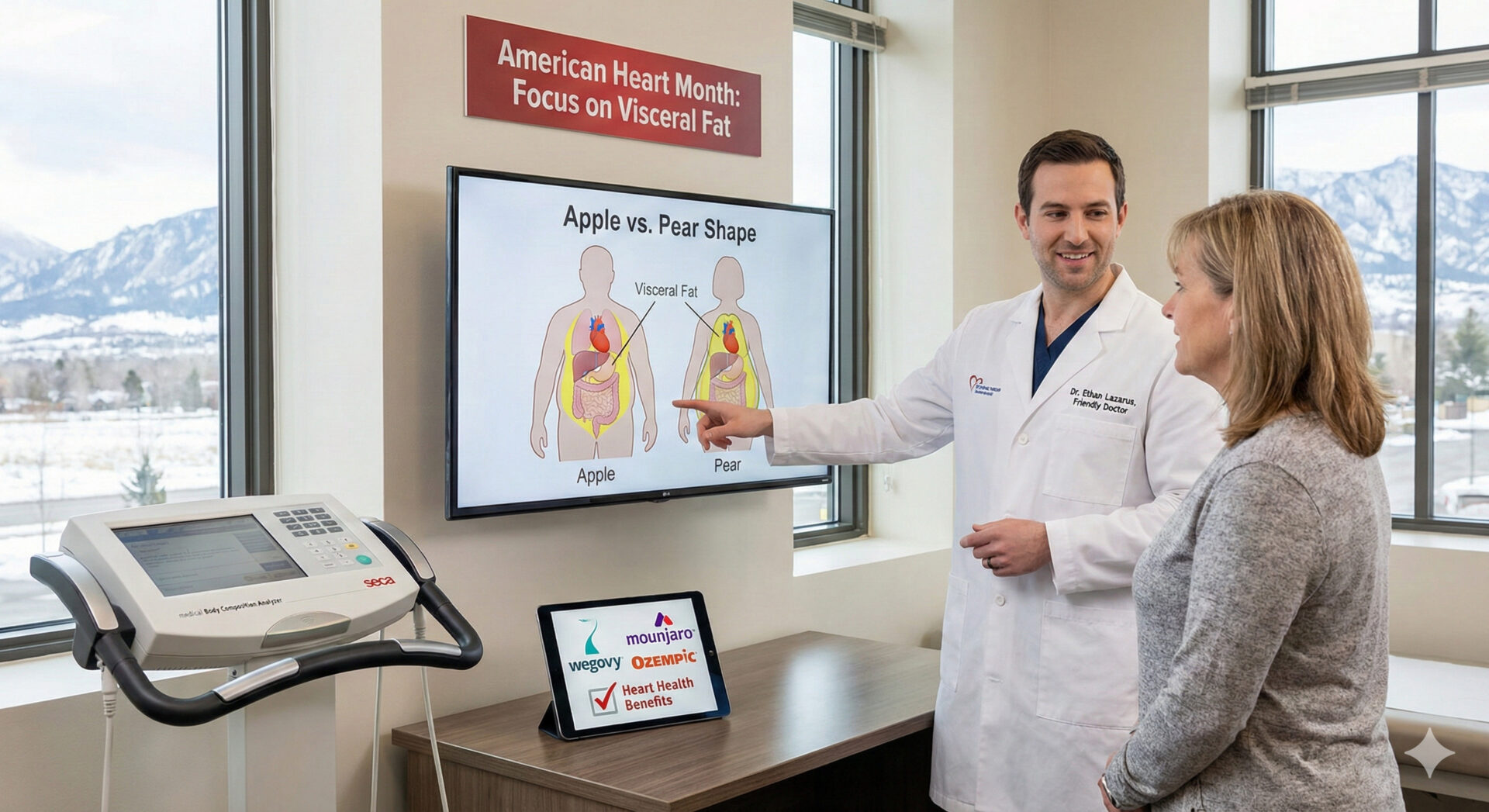
For a long time, we thought body fat was just extra energy storage—like a backpack of batteries that you carry around all day. We now know that is not true. Fat is actually an active tissue that sends signals to the rest of your body. However, the location of that fat changes the signal.
- Subcutaneous Fat: This is the fat you can pinch. It sits right under your skin on your arms, legs, and hips. Surprisingly, this fat is relatively harmless regarding heart disease.
- Visceral Fat: This is the fat you can’t pinch. It is stored deep inside your belly, wrapping around your heart, liver, pancreas, and intestines.
Visceral fat is the troublemaker. It acts like an angry organ, pumping out inflammatory chemicals that stiffen your arteries, raise your blood pressure, and make your body resistant to insulin.

Looking Inside: Beyond the Scale
Because a standard bathroom scale can’t tell us where your fat is located, we use advanced technology to get a true picture of your health.
While a simple tape measure can give us a rough idea (risk increases if waist circumference is >40 inches for men or >35 inches for women), at the Clinical Nutrition Center, we use the SECA mBCA (medical Body Composition Analyzer).
This non-invasive device gives us a “look inside” your body. In less than a minute, it measures your exact body composition, telling us precisely how much dangerous visceral fat you are carrying versus healthy glp-1-weight-loss-medications”>glp-1/the-critical-need-for-muscle-defense-how-to-win-the-war-on-lemuscles-loss-while-taking-glp-1s”>muscle mass. This data allows us to track your progress in a way the scale never could—ensuring you are losing the right kind of weight to protect your heart.
New Data: Weight Loss Medications Save Hearts
We have known for years that losing weight helps the heart. But recently, we received powerful new data confirming that modern anti-obesity medications do much more than just lower the number on the scale—they directly prevent heart attacks and strokes.
The results from recent major clinical trials have been nothing short of game-changing:
- wegovy-and-zepbound“>wegovy-weight-loss-treatment-program-in-denver-meddenvereight-loss-guide-to-the-new-wegovy-pill”>denver” target=”_blank” rel=”noopener” title=””>Wegovy (tirzepatide-glp1-nutrition-weight-loss”>semaglutide–zepbound-now-available-through-lillydirect-a-new-option-for-tirzepatide-access-at-a-predictable-price”>tirzepatide-glp1-nutrition-weight-loss”>Szepboundde 2.4mg):semaglutidezepatide-lowers-risk-of-heart-attack-stroke-and-cardiovascular-death”>mounjaro-tirzepatide-lowers-risk-of-heart-attack-stroke-and-cardiovascular-death”>cardiovascular death by 20%.
- ozempic-weight-loss-treatcardiovascularider” target=”_blank” rel=”noopener” title=”Now Available! Ozempic® Weight Loss Medication Program in Denver”>Ozempic (Semaglutide 1.0mg): In the SUSTAIN-6 trial, this medication was shown to lower cardiovascularZepbound approximately 26%.
- Mounjaro / Zepbound (Tirzepatide): Recent data indicates an impressive 28% reduction in cardiWegovylar events for patients with diabetes and heart disease.
- Oral Wegovy (Rybelsus): Initial safety trials have shown an approximate 21% reduction in cardiovascular risk.
Note: While these numbers are exciting, research is ongoing. Further heart safety trials are currently in the works to learn even more about how these medications protect the cardiovascular system.
The Diabetes Link & The “10% Solution”
Your weight and your blood sugar are intimately linked to your heart. If you have Pre-Diabetes (an A1C of 5.7% or higher) or type 2 diabetes, your risk for heart disease is significantly elevated.
This is why we focus so heavily on the “10% Solution.”
You don’t need to lose all the weight to see massive health benefits. Studies show that losing just 10% of your total body weight can dramatically improve your heart health, lower your A1C, and reduce inflammation. This is because when you lose weight, you lose visceral fat first.
The challenge, of course, has always been sustaining that weight loss. This is where our medical programs shine. While diet and exercise“>exercise alone often lead to “yo-yo” dieting, addingColoradoht medical support increases the odds of losing and sustaining that critical >10% weight loss.
Protect Your Heart This February
Living in Colorado, we want to be active—skiing, snowshoeing, or hiking the trails. Carrying excess visceral fat pushes against your diaphragm and lungs, making it harder to breathe at our high altitude. When our patients lose that visceral weighheart healthn tell me, “Dr. Lazarus, I can finally breathe again!”
If you are concerned about your heart health, pre-diabetes status, or that stubborn weight around your midsection, let’s look at the data together. Whether using our SECA analyzer to track your visceral fat or utilizing these heart-protective medications, we have the tools to help you live a longer, healthier life.
Stay warm and healthy,
Dr. Ethan Lazarus
References & Cardiovascularg
- New England Journal of Medicine: Semaglutide and Cardiovascular Outcomes (SELECT Trial)
- American Heart Association: Understanding Metabolic Syndrome
- Clinical Nutrition Center: Medical Weight Loss Programs