


A New Study Says Body Fat Percentage Predicts Death Better Than BMI. Here’s What That Means for Your Health.
A study published last June in Annals of Family Medicine should change how your doctor talks to you about your weight — and how you think about what the scale is actually telling you.
Researchers from the University of Florida analyzed 15-year mortality data on U.S. adults ages 20 to 49. They compared three body composition measures: BMI, body fat percentage, and waist circumference. The results were unambiguous.
Adults with high body fat percentage — 27% or more in men, 44% or more in women — were 1.78 times more likely to die from any cause than those in the healthy body fat range. They were 3.62 times more likely to die from heart disease.
BMI couldn’t predict either outcome.
Why BMI Gets It Wrong
The study’s lead author, Dr. Arch Mainous, put it plainly: “BMI is just so ingrained in how we think about body fat. I think the study shows it’s time to go to an alternative that is now proven to be far better at the job.”
BMI divides weight by height squared. It can’t tell the difference between fat and muscle. It routinely misclassifies muscular individuals as overweight. It also misses what researchers call “normal-weight obesity” — people who have a normal BMI but elevated body fat percentage and the same metabolic risk as someone who looks clinically obese by BMI standards.
We’ve written before about waist-to-height ratio as a better proxy. This new study takes it further: direct body fat percentage measurement beats all of them.
The Technology Already Exists — And We Use It
Here’s the part that matters for your next visit: measuring body fat percentage accurately doesn’t require a research lab. Bioelectrical impedance analysis (BIA) — the same technology used in the study — is available in most clinical settings with the right equipment.
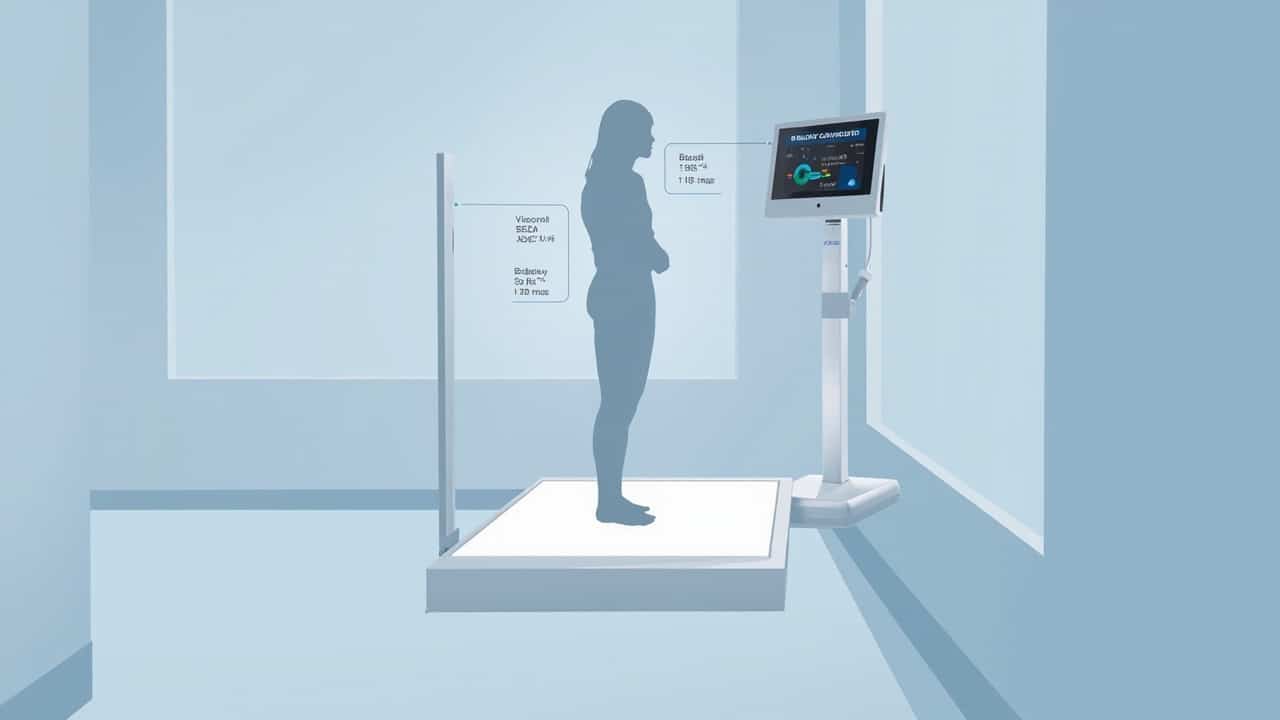
At Clinical Nutrition Center, we use the SECA 554 body composition scale for exactly this purpose. It measures:
- Body fat percentage
- Visceral fat estimate
- Fat mass and muscle mass separately
- Basal metabolic rate
In a single standing — no needles, no Bod Pod, no DEXA exposure.
The study’s authors specifically noted that BIA is “relatively inexpensive” and feasible in office-based practice. That’s exactly what we’re doing.
What This Means for Your Care
If you’ve been tracking your health by weight alone — or by BMI alone — you’re flying partially blind. The number on the scale doesn’t tell you whether you’ve lost fat or muscle. A high BMI on a muscular football player looks dangerous when it isn’t. A normal BMI in someone with high visceral fat looks fine when it isn’t.
Body fat percentage changes the conversation. It gives your physician a target that actually correlates with what we’re trying to improve: survival, heart health, metabolic function.
When I see a patient’s body fat percentage is elevated — even if their BMI is normal — that’s a different clinical conversation than someone whose BMI puts them in the “overweight” category but whose body fat is in a healthy range.
Ask us about body composition testing at your next visit. The scale has been lying to you long enough.
Dr. Ethan Lazarus, MD, DABOM, DABFM, MFOMA | Clinical Nutrition Center, Greenwood Village, CO
Call (303) 750-9454 · clinicalnutritioncenter.com