

Protein on GLP-1s: How to Eat to Preserve Muscle and Keep Losing Fat | Denver
A patient came in last month frustrated. She’d been on a GLP-1 medication for four months, had lost 18 pounds — and yet her body composition told a different story. She’d dropped muscle, not just fat. When I asked her what she’d been eating, she shrugged. “I just don’t have much of an appetite anymore. I maybe eat one real meal a day.”
That’s the hidden trap of GLP-1 medications. They work beautifully. They also turn down your hunger dial so effectively that a lot of patients end up undereating the one nutrient that matters most during active weight loss: protein.
Why Protein Becomes Non-Negotiable on GLP-1s
Here’s the thing about protein that a lot of people miss: it’s not just about satiety. Protein is the building block of muscle — and muscle is your metabolic engine.
During weight loss, your body has to decide where to pull its energy from. Ideally, it’s pulling from fat stores. But when you’re in a calorie deficit without adequate protein and without resistance training, your body will pull from muscle too. Studies suggest that without deliberate effort, up to 40% of weight lost can be lean mass — not fat.
That’s a problem. Muscle is metabolically expensive. It burns calories at rest. Lose it, and your resting metabolic rate drops. You then need fewer calories to maintain your weight, which makes long-term weight management harder. The scale goes down, but the body composition gets worse.
On GLP-1 medications specifically, this problem is amplified. The appetite suppression is real and effective. When you’re not hungry, it’s easy to eat “intuitively” — which during a deficit often means eating far too little protein.
The Number You Need: 1.2 to 1.6 Grams per Kilogram
During active weight loss, the evidence consistently points to a target of 1.2 to 1.6 grams of protein per kilogram of body weight per day. For a 180-pound person, that’s roughly 100 to 130 grams of protein daily.
That’s higher than the standard RDA. It’s not a gimmick — it’s what the data shows is needed to preserve lean mass when you’re deliberately undereating. If you’re actively trying to lose fat while on a GLP-1, you need more protein, not less.
Let me be direct: most of my patients on these medications are getting nowhere near this amount. The one-meal-a-day pattern I described above? That patient’s protein intake was probably somewhere around 40 to 50 grams on a good day. That’s half of what she needed.
Distribute It: 3 to 4 Meals, Not One
It matters not just how much protein you eat, but when. Muscle protein synthesis — the process by which your body builds new muscle — is maximized when you give it roughly 25 to 40 grams of protein per meal, spread across three or four eating occasions.
If you’re eating all your protein in one dinner, you’re leaving muscle-building potential on the table. Your body can only synthesize so much muscle at once from a given amino acid pool. Spread it out.
Think of it this way: if you need 120 grams of protein a day, and you’re eating three meals, that’s 40 grams per meal. That’s a chicken breast and an egg or two at each meal. Is that convenient? Not always. But it’s what the biology requires.
Protein Without Resistance Training: The Caveat Nobody Talks About
I need to be honest about something that the supplement industry conveniently ignores: protein alone does not build muscle. You need amino acids from dietary protein, yes — but you also need a stimulus. That stimulus is resistance training.
Without resistance training, excess protein is not efficiently converted to muscle. It can be used for energy, stored as fat, or excreted. Protein without the mechanical load of resistance training does not maximally preserve muscle during weight loss.
This doesn’t mean you need a gym membership or heavy weights. Bodyweight exercises, resistance bands, even walking with weighted vests can provide the stimulus. What matters is consistent mechanical loading that tells your body: this muscle is needed, preserve it.
My practical recommendation: if you’re on a GLP-1 and trying to lose weight, aim for two to three resistance sessions per week. It doesn’t have to be an hour. Twenty minutes of meaningful work is enough. The return — in metabolic preservation, in body composition, in long-term weight maintenance — is substantial.
What This Looks Like in Practice
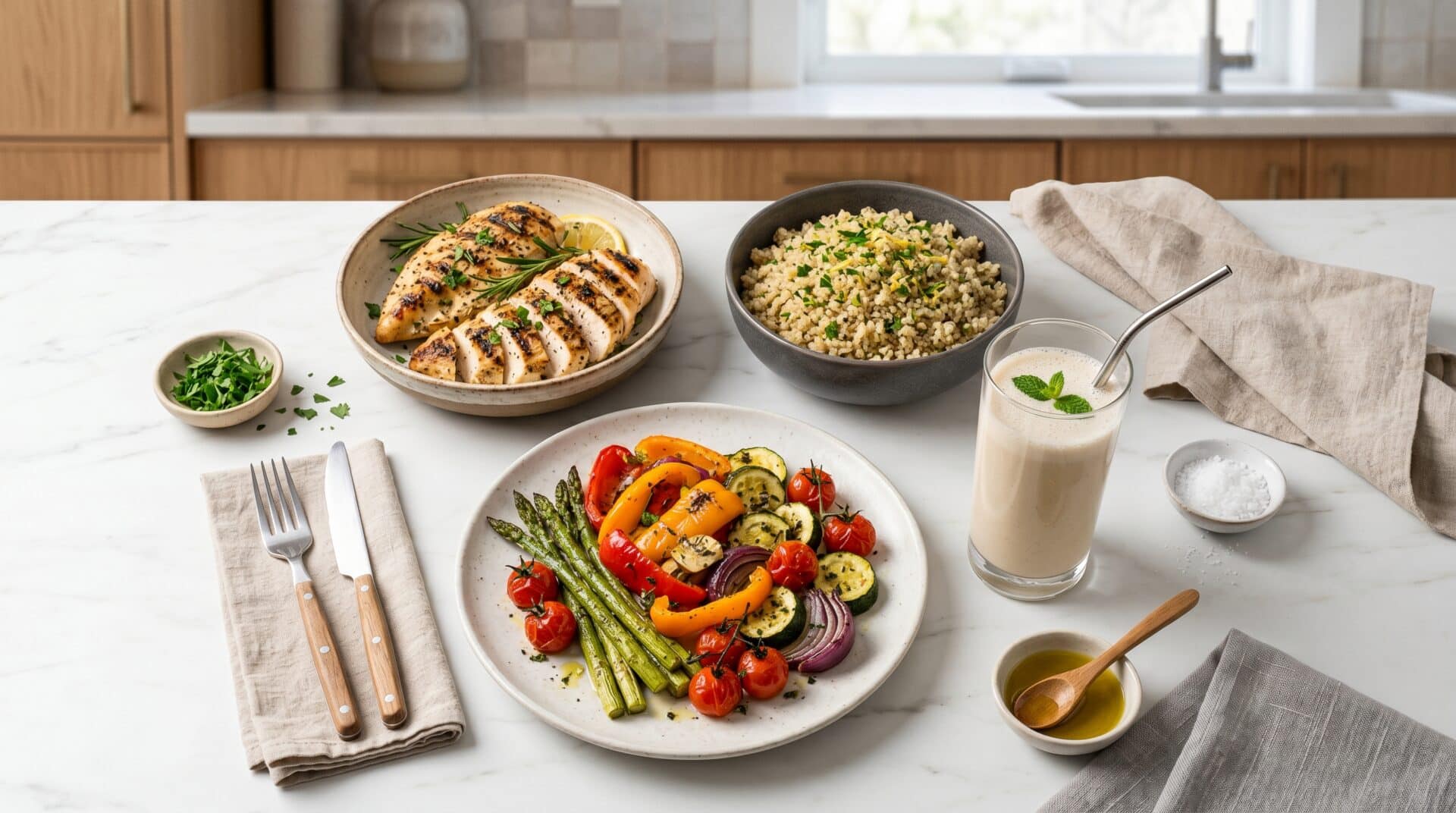
Here is what a protein-aware day might look like for someone on a GLP-1 medication targeting around 120 grams of protein:
- Breakfast: 3 eggs (18g) + Greek yogurt (15g) + 1 ounce cheese (7g) = ~40g
- Lunch: 4 to 5 ounces grilled chicken or fish (30-35g) + legume base = ~35-40g
- Dinner: 4 to 5 ounces salmon or lean beef (30-35g) + vegetables = ~35-40g
That gets you to roughly 110 to 120 grams. Add a glass of milk or a small protein-rich snack and you’re comfortably there.
If you eat vegetarian or vegan, legumes, tempeh, seitan, tofu, and Greek yogurt are all viable protein sources. You’ll need to be more deliberate about hitting the target, but it’s entirely doable.
The Bottom Line
GLP-1 medications are powerful tools. They work. But they introduce a specific risk that I see constantly in my practice: insufficient protein intake leading to muscle loss during what should be a fat-loss process.
Your job: be deliberate about protein. Track it for a few days if you need to. Aim for 1.2 to 1.6g per kg of body weight. Spread it across three to four meals. Pair it with resistance training at least twice a week.
Your doctor’s job: monitor your body composition, not just the scale. If your weight is coming off but your muscle is dropping, we need to adjust the plan.
If you’re on a GLP-1 medication and want to understand whether your nutrition and exercise plan is set up to preserve muscle while you lose fat, talk to our team. We do body composition tracking as part of our standard care, and we can help you build a plan that actually works long-term.
Call us at (303) 750-9454 or book a visit online.