


Is It Worth Investing in a Body Fat Scale?
The number you get when you step on a standard bathroom scale is a measure of your total body weight. That weight can come from bone, muscle, fat, water weight, or food that hasn't passed out of your system. You may notice that you lose or gain weight from day to day, but who much of what you gained or lost is body fat?
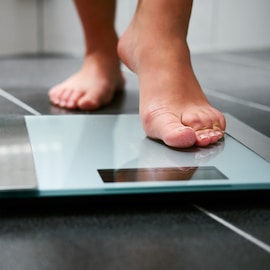
The number you get when you step on a standard bathroom scale is a measure of your total body weight. That weight can come from bone, muscle, fat, water weight, or food that hasn’t passed out of your system. You may notice that you lose or gain weight from day to day, but how much of what you gained or lost is body fat?
It would be useful to have a way to measure changes in body fat as opposed to weight since only a percentage of total body weight is fat. In fact, your body weight can change by as much as 5 pounds if you eat a very large meal and retain water due to the high salt content.
You may have noticed ads for body fat scales that measure body fat percentage. These scales work by the principle of bioelectrical impedance. They’re available in a hand-held form and a scale you step on with your feet. Most people choose the latter version and use it in place of a bathroom scale.
How Body Fat Scales Work
When you stand on the scale, it shoots a harmless electrical current through your feet. Since fat conducts energy more slowly than muscle, a body fat scale can give you a good idea of your body fat percentage.
Sounds convenient, doesn’t it? But, are these scales accurate? The problem with scales that use bioelectrical impedance is they’re sensitive to changes in hydration status, how much fluid you have on board when you step on the scale. When you’re dehydrated, the scale tends to overestimate your body fat percentage. Likewise, if you just chugged a large container of water, the reading may look like your body fat percentage is lower than it actually is. So, in an absolute sense, they aren’t that reliable.
What body fat scales that use bioelectrical impedance are useful for is monitoring changes in body fat composition. But to get reliable results, you have to use the scale at the same time each day under the same conditions. The best time to step on a body fat scale is first thing in the morning after urinating and before drinking fluid or eating. Even then, expect some variation based on hydration, recent exercise, and for women, where you are in your menstrual cycle.
How accurate are today’s smart scales?
Modern bioelectrical impedance scales — like the Withings Body Comp, Fitbit Aria 3, and Tanita RD-545 — are more sophisticated than earlier models. Many now claim ±3-4% accuracy for body fat percentage. They’re useful for tracking trends over weeks and months, even if any single reading shouldn’t be taken as gospel. Some models also estimate visceral fat rating, skeletal muscle mass, and resting metabolic rate.
Compared to other methods, body fat scales fall short of gold standards:
- DEXA scan — still the gold standard for body composition, now more widely available at imaging centers. Low-dose radiation exposure. Best for one-time assessment or quarterly check-ins, not weekly tracking.
- Hydrostatic weighing — highly accurate but requires specialized facilities. Impractical for ongoing monitoring.
- InBody 570 — uses multi-frequency BIA and is increasingly available at clinics and gyms. More accurate than home scales, still more practical than DEXA.
- Skinfold calipers — inexpensive but require skill. The 7-site Jackson-Pollock method is a learned skill.
Bottom line: A good body fat scale in 2026 ($50-$150) is a reasonable tool for monitoring trends if you use it consistently — same time, same conditions, same hydration. Don’t chase daily numbers. Look at 4-week rolling averages. If you’re on a GLP-1 medication or working with a physician-led weight loss program, body composition changes are one of the most useful metrics to track alongside weight.